








IMCP와 스킬의 차이점
1. MCP란 무엇입니까?
MCP(Model Context Protocol)은 AI 애플리케이션이 외부 데이터 및 도구에 연결할 수 있도록 하는 개방형 프로토콜 세트입니다. MCP가 연결되면 사용자는 AI 에이전트에 자연어로 명령하여 MCP 도구 및 기능을 호출하여 AppGrowing의 풍부한 글로벌 모바일 광고 소재 및 광고 집행 데이터를 검색하고 얻습니다.
2. MCP와 스킬의 관계
스킬은 일반적으로 AI 에이전트가 도구를 사용하기 위한 일련의 지침, 규칙 및 호출 프로세스입니다. 여기에는 AI가 MCP를 호출하도록 안내하는 흐름도 포함되는 경우가 많습니다.
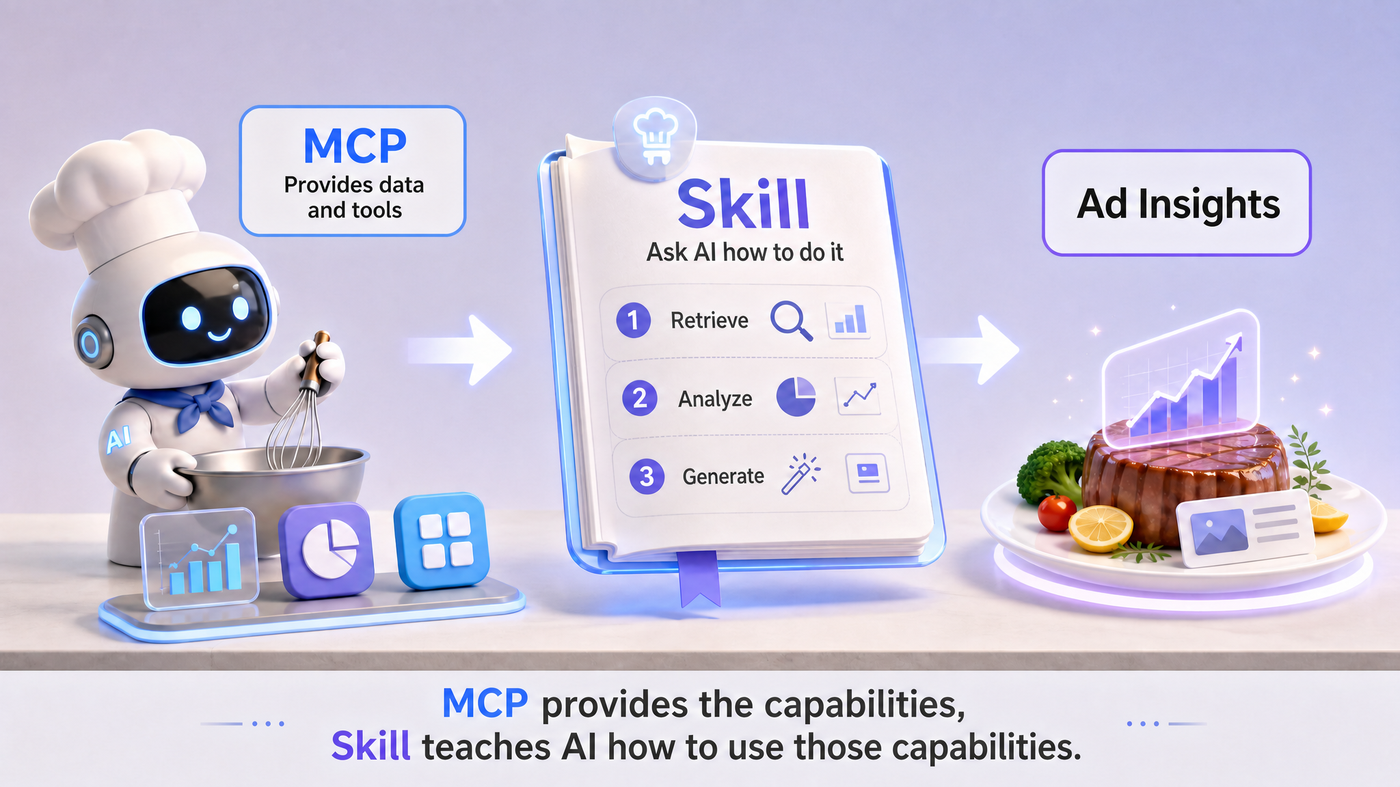
MCP = 주방용품 및 재료, 다양한 기본 능력을 제공합니다.스킬=레시피, 어떤 재료를 사용해야 하는지, 어떤 순서로 만드는지 알려줍니다.
예를 들어:
MCP : 계란, 밀가루, 우유, 오븐 · 스킬: 케이크 만들기 방법
AppGrowing의 경우:
MCP: 소재 데이터, 출시 데이터, 경쟁 데이터, 시장 데이터 · 스킬: 인기 광고 소재 분석 방법
한마디로:
AppGrowing MCP는 AI에게 "어떤 데이터가 있는지" 알려주고 스킬은 AI에게 "효과적인 통찰력을 위해 데이터를 호출하고 데이터를 사용하는 방법"을 알려줍니다.
- MCP는 AppGrowing의 기능을 AI 에이전트에 연결하는 역할을 담당합니다.
- 스킬은 에이전트가 사용자의 요구 사항을 이해하고 올바른 도구를 선택하도록 돕는 역할을 합니다.
- MCP 도구는 데이터 검색 및 반환을 담당합니다.
- AI 에이전트는 반환된 데이터를 분석하고, 출력을 통합하며, 후속 질문에 대한 세션 컨텍스트를 유지합니다.
예를 들어, 사용자는 "지난 30일 동안 미국 시장에서 SLG 게임의 소재 동향을 분석합니다"라고 말했습니다.
- MCP는 AI 에이전트가 AppGrowing의 소재 분석 도구를 호출할 수 있도록 하는 역할을 담당합니다.
- 스킬은 "미국 시장, SLG, 거의 30일, 추세 분석"과 같은 조건에 대해 MCP에 어떤 데이터가 전달되는지 식별하고 분석에 데이터를 사용하는 방법을 AI에게 가르치는 역할을 담당합니다.
- MCP 도구는 데이터를 검색하고 반환하는 역할을 담당합니다.
- AI 에이전트는 반환된 데이터를 분석하고 출력을 통합하여 후속 후속 질문을 위한 세션 컨텍스트를 저장합니다.
IIAppGrowing MCP 기본정보
2.1 AppGrowing MCP에는 현재 어떤 도구가 있습니까?
이제 MCP를 통해 4개 핵심 모듈의 전문 도구 21종과 기본 도구 1종을 사용할 수 있습니다. 핵심 모듈은 소재 검색 및 소구점 분석(5종, 아래 표 참조), 차트 인텔리전스(3종), 앱 광고 분석(11종), 퍼블리셔 및 개발사 인텔리전스(2종)로 구성됩니다.
이 중 소재 검색 및 소구점 분석은 AppGrowing의 핵심 차별화 기능입니다. 지속적으로 업데이트되는 30만 개 이상의 광고 소재 소구점 데이터를 기반으로 소재 탐색과 분석을 지원합니다. 여기에 차트, 앱 광고, 퍼블리셔 분석을 결합하면, 에이전트는 누가 어느 규모로 광고를 집행하는지부터 어떤 소재를 활용하고 무엇이 그 효과를 이끄는지까지 광고 전략 전반을 파악할 수 있습니다.
| 도구 | 기능 | 한 줄 시나리오 | 크레딧 소모 |
|---|---|---|---|
| 소재 검색&판매 포인트(4) - AppGrowing MCP의 차별화 핵심 | |||
| searchAdCreatives | 소재 검색 (미디어/지역/판매 포인트/오디언스/수익화 방식 등으로 필터링) | TikTok에서 거의 30일 동안 진행된 롤플레잉 소재 | 100/item |
| creativeSellingPointTrends | 💡 광고 소재의 소구점 트렌드(300,000개 이상의 어휘, 소재 수/광고 수/인기순으로 정렬) | 롤플레잉 부문에서 모든 사람들이 플레이하는 장점은 무엇입니까? | 100/item |
| creativeAIAnalysisData | 소재 내레이션 / 판매 포인트 / AI 해석 (호출당 최대 100개) | 최근 7일 동안 제품의 인기 소재에 대한 판매 포인트 및 내레이션을 추출합니다. | 100/item |
| creativeResourceUrl | 광고 소재의 원본 동영상/표지 다운로드 링크를 받으세요. 링크에는 유효기간이 있습니다. | 광고 소재의 원본 이미지/동영상 가져오기 | 100/item |
| 차트 인텔리전스(3) — "누구를 먼저 볼지" 결정 | |||
| appAdRankings | 앱 프로모션 순위(브랜드 수준, 라이브 광고 수, 소재 수, 대상 프로필, 게시자 및 개발자 ID 포함) | 지난 7일 동안 미국에서 UA 광고를 가장 활발히 집행한 게임은 무엇인가요? | 100/item |
| appStoreDownloadRankings | iOS App Store 다운로드 차트 | 일본 다운로드 차트에 진입한 새로운 퍼즐 타이틀은 무엇입니까? | 100/item |
| googlePlayDownloadRankings | Google Play 다운로드 차트 | 도구 카테고리에서 미국 Android 다운로드 1위를 차지한 사람은 누구인가요? | 100/item |
| 앱 광고 분석(11) — 누가, 얼마나, 어디서, 무엇을 광고하고 있는지 | |||
| adVolumeTrends | 일별 광고 수와 소재 수 추이 | 경쟁사는 매주 신규 광고 소재를 몇 개 씩 집행하나요? | 100/call |
| regionOverview | 지역별 개요: 국가/지역별 규모 및 점유율 | 예산이 어느 시장에 집중되어 있습니까? | 100/call |
| regionTimeline | 지역별 타임라인: 시간이 지남에 따라 각 시장의 거래량이 어떻게 변하는가 | 시장 초점이 출시에서 안정 상태로 이동하는 방법 | 100/call |
| mediaOverview | 미디어 믹스 개요: 미디어 채널별 볼륨 및 점유율 | 이 제품은 Meta에 기대고 있나요, 아니면 TikTok에 기대나요? | 100/call |
| mediaTimeline | 미디어 타임라인: 시간이 지남에 따라 각 채널의 볼륨이 어떻게 변하는지 | TikTok에서 언제 규모가 커지기 시작했나요? | 100/call |
| adFormatOverview | 광고 형식 개요: 플레이어블 광고, 보상형 동영상 광고, 인피드 광고 및 기타 형식 | 경쟁사에서는 이미 대규모로 플레이어블 광고를 게재하고 있나요? | 100/call |
| creativeTypeOverview | 소재 유형 개요: 이미지/동영상/세로형 동영상 배포 | 이 앱은 이미지로 싸우는 걸까요, 아니면 영상으로 싸우는 걸까요? | 100/call |
| creativeFormatRatio | 종횡비 개요: 세로/가로 및 크기 분포 | 이 앱은 가로 광고를 선호하나요, 세로 광고를 선호하나요? | 100/call |
| audienceBreakdown | 연령별 관객수 × 성별 | 광고 소재가 타겟팅해야 하는 연령대와 성별은 무엇인가요? | 100/call |
| appLifecycle | 제품 수명 주기/버전/페스티벌 마일스톤 시기 | 대규모 업데이트 전후로 이용자 확보 광고의 집행 패턴이 어떻게 달라지나요? | 100/call |
| similarApps | 유사/관련 제품(유사성 또는 평생 다운로드 기준으로 정렬 가능) | 이 SLG에 대한 10개의 직접 벤치마크를 찾아보세요. | 100/call |
| 퍼블리셔 &개발자 인텔리전스(2) - 회사 수준까지 제품 출시 | |||
| developerAppOverview | 개발자 소속 제품 | 동일한 개발자가 동일한 카테고리의 앱을 몇 개 실행합니까? | 100/call |
| publisherAppOverview | 게시자 아래의 모든 제품(라이브 광고, 광고 소재, 실행일, 버전 수, 지역 수) | 이 퍼블리셔가 광고를 집행 중인 앱은 몇 개이며, 각 앱의 광고 집행 규모는 어느 정도인가요? | 100/call |
| 기본 도구 (1) | |||
| filterOptions | 선택적 필터 값(미디어/지역/카테고리/스타일/판매 포인트 카테고리)을 모두 반환합니다. | TikTok의 미디어 ID는 무엇입니까? | 100/call |
2.2 🔥 AppGrowing MCP의 가장 독특한 기능 — 광고 소재의 소구점 시스템
| 계층 | 도구 | 역량 | 예시 |
|---|---|---|---|
| ① 그림요소 | searchAdCreatives.resourceElement | 화면 요소 라벨의 인라인 반환(설명 포함) | 현실적인 스타일, 3D, 만화 캐릭터, SF 스타일, 실제 사람 |
| ② 판매 포인트 심사 | searchAdCreatives.marketingWord | 🔥30만 개 이상의 광고 소재 소구점 단어로 광고 소재 필터링 | 고채도 효과 컬러, 스트레스 해소, 하이 앵글 촬영, 성취감, 단편적인 시간 |
| ③ 판매 포인트 동향 | creativeSellingPointTrends | 판매 포인트 단어 트렌드 리스트 (광고/광고/인기순) | 최근 가장 인기 있는 판매 포인트 단어 찾기 카테고리의 상위 N개 |
지금까지 반환된 판매 포인트 어휘는 다음과 같습니다.creativeSellingPointTrendsAppGrowing MCP가 초과되었습니다.300,000+— 고정 태그 시스템과 달리 AppGrowing의 광고 소재의 소구점은 다음과 같습니다.AI 알고리즘을 통해 대규모 소재에서 자동으로 식별: 어휘 업데이트는 역동적이고 지속적으로 새로운 광고 소재의 소구점을 생성합니다.
다루는 범위: 시각적 스타일(고채도 효과 컬러 / 웜톤 메인 톤),렌즈 언어(중간 장면 클로즈업 / 머리 위 각도),청중 동기부여(캐주얼 플레이어/성취감/쉬운 감압),장면 레이아웃(아름다운 생활 장면 / 세로 목록 레이아웃) 등 — 세분성이 매우 좋습니다.
그림 요소에서creative.resourceElement[].description, 각 라벨에는 라벨에 이런 방식으로 태그가 지정된 이유를 알려주는 진정으로 유익한 판단 수준의 설명이 포함되어 있습니다. 예를 들어:
| 태그 이름 | 설명(판정구경) |
|---|---|
| 만화 캐릭터 | 의인화한 동물(예: 원숭이 왕/돼지)을 제외한 일본식 애니메이션 또는 국내 애니메이션 기반 캐릭터 유형. |
| 3D | 문자와 개체에는 검은색/가는 선 획이 없고 빛과 그림자 효과가 뚜렷하며 개체의 겹치는 부분에는 3D로 간주되는 획이 없습니다. 혼합형은 포함되지 않습니다. |
| 애니메이션 스타일 | 출처에는 일본-한국 스타일(동부)과 유럽-미국 스타일(서부) 애니메이션이 포함됩니다. 사진은 대표적인 애니메이션 이미지로 Q버전의 귀여운 스타일과 일본/유럽-미국 만화 애니메이션으로 나누어져 있습니다. |
| 현실적인 스타일 | 3D 모델링 스타일, 강력한 빛과 그림자 효과를 갖춘 생생한 그림(극도로 시뮬레이션된 사람과 개체 포함)은 진나라 전사, NBA2K, FIFA 등과 같은 게임에서 흔히 볼 수 있습니다. |
| 유럽식과 미국식 | 유럽/북미/남미 및 기타 역사적&중세 갑옷, 성, 서부 카우보이, 미국 삼촌 등에서 흔히 볼 수 있는 현대적인 고유 요소 |
| 실제 장면 | 사무실, 해변, 자동차 등 실제 장면이 광고 소재에 나타납니다. |
| 실제 사람 | 실제 자연인 또는 매우 사실적인 CG 캐릭터. |
| 미니멀리스트 스타일 | 그림은 단순하며 일반적으로 요소가 3개 이하이고 요소는 평면적입니다. 이는 Stickman 게임에서 흔히 볼 수 있습니다. |
| 픽셀 스타일 | 선명한 윤곽선, 밝은 색상, 세분화된 픽셀을 강조하여 독특한 영상 스타일을 구성하는 픽셀 스타일의 이미지 처리입니다. |
| 동물 | 소, 말, 양 및 기타 가금류/동물. |
2.3 도구별 매개변수 안내
21개 도구 모두의 전체 매개변수 세부 정보, 정렬 열거 및 호출 예제를 대화형 도구 색인 페이지로 정리했습니다. 아래 버튼을 눌러 새 창에서 열 수 있습니다.
IIIAppGrowing MCP 구성 및 호출
3.1 AppGrowing MCP 구성 방법
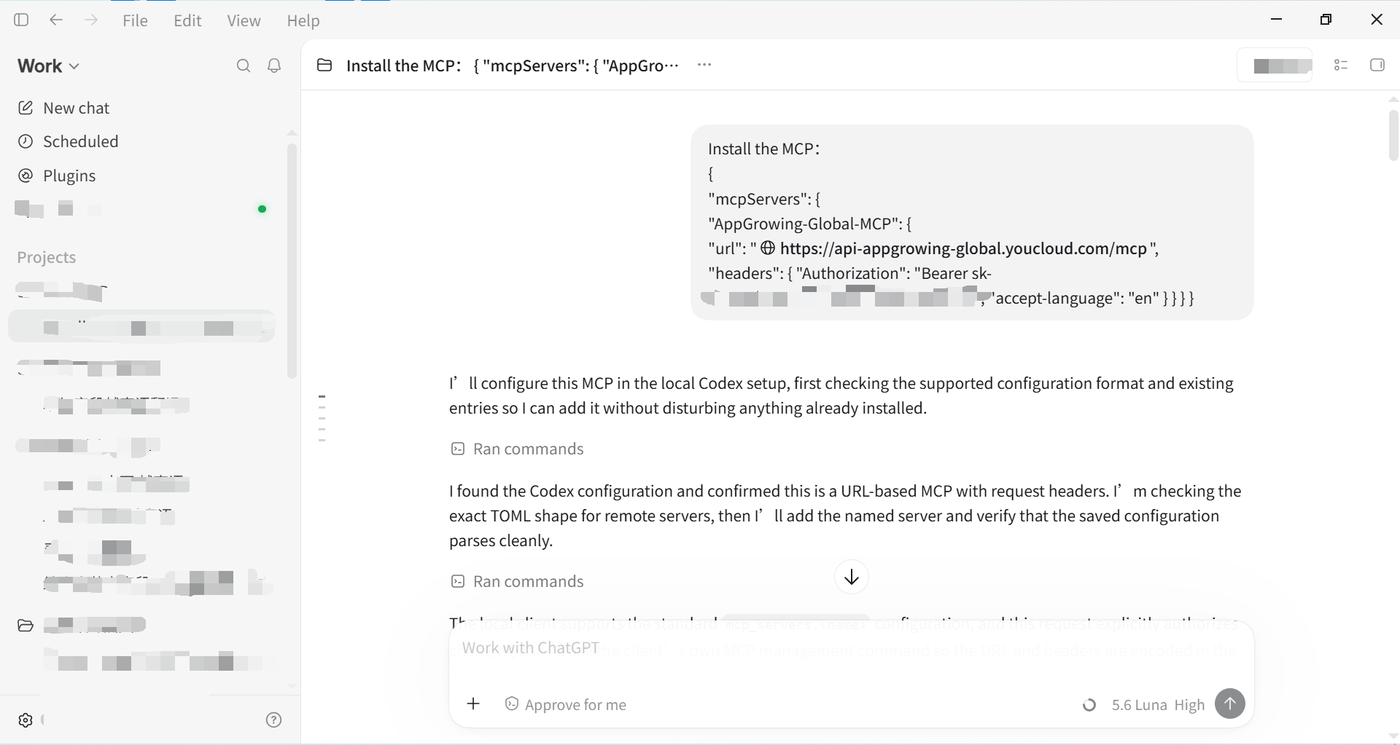
아래 명령을 복사해 에이전트 대화 상자에 그대로 입력하면 에이전트가 실행합니다. 명령 안의 API Key 🔑 API 키 받기 부분을 본인의 API Key로 교체하세요. API Key는 "개인 센터 → 기업 정보"에서 확인할 수 있습니다. Accept-Language는 언어 코드로 교체할 수 있습니다: zh는 중국어, en은 영어, kr은 한국어입니다.
이 MCP를 설치합니다:
{
  "mcpServers": {
    "AppGrowing-Global-MCP": {
      "url": "https://api-appgrowing-global.youcloud.com/mcp",
      "headers": {
        "Authorization": "Bearer YOUR_API_KEY",
        "Accept-Language": "kr"
      }
    }
  }
}
설치가 완료될 때까지 기다린 후 대화 상자를 호출해 보십시오. 결과가 반환되면 구성이 성공한 것입니다.
- 명령어를 입력하고 Codex로 보내세요
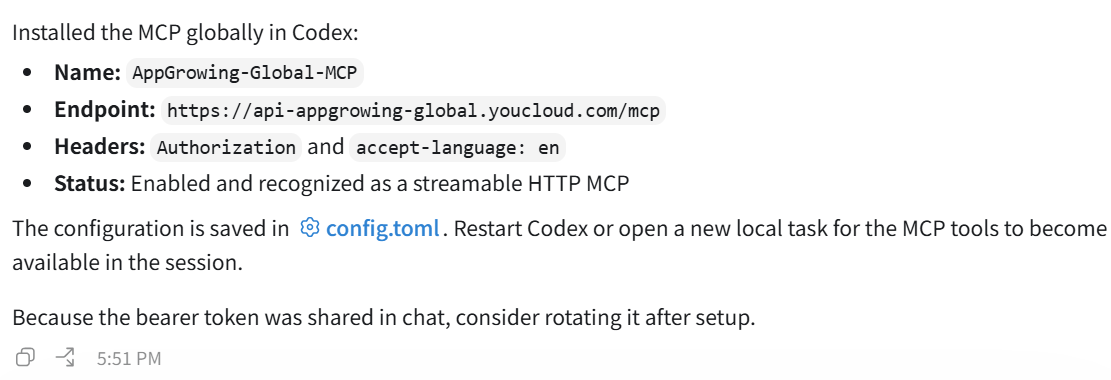
- Codex는 MCP 구성을 구성 파일에 기록합니다.
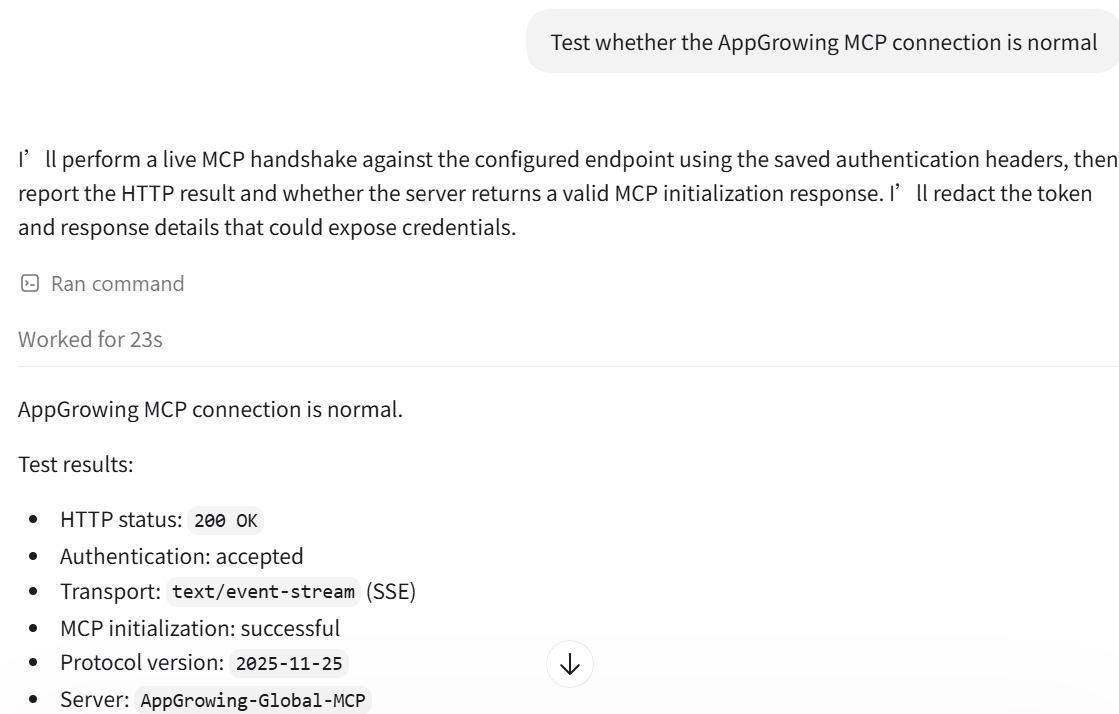
- MCP 연결이 정상인지 테스트합니다. 정상적인 결과가 반환되면 MCP 서비스 연결에 성공한 것입니다.
3.2 자연어를 통해 MCP 호출
정상적인 액세스 후에는 사용자가 매개변수를 제공할 필요가 없습니다. 자연어를 직접 사용하여 대상, 범위 및 분석 초점을 설명합니다. 다음의 일반적인 통화 예를 참조할 수 있습니다.
자연어로 MCP를 호출할 때 MCP 비용을 최소화하고 에이전트가 광고 소재 검색 도구를 과도하게 호출하여 너무 많은 크레딧을 소모하는 것을 방지하기 위해 프롬프트에서 검색할 광고 소재 수를 명시적으로 지정하는 것이 좋습니다.
MCP 도구 계층은 에이전트 컨텍스트로 반환된 데이터를 자르므로 대규모 광고 소재 배치가 전체적으로 반환되지 않을 수 있습니다. 대량의 광고 소재를 가져와야 하는 경우 스크립트를 사용하여 MCP 엔드포인트를 직접 호출하고 데이터가 에이전트 컨텍스트로 다시 흐르도록 하는 대신 응답을 작업공간에 JSON 파일로 저장합니다. 에이전트는 필요할 때 JSON 파일을 읽습니다. 스크립트 예제는 다음에서 제공됩니다.FAQ-Q2.
콜 체인:
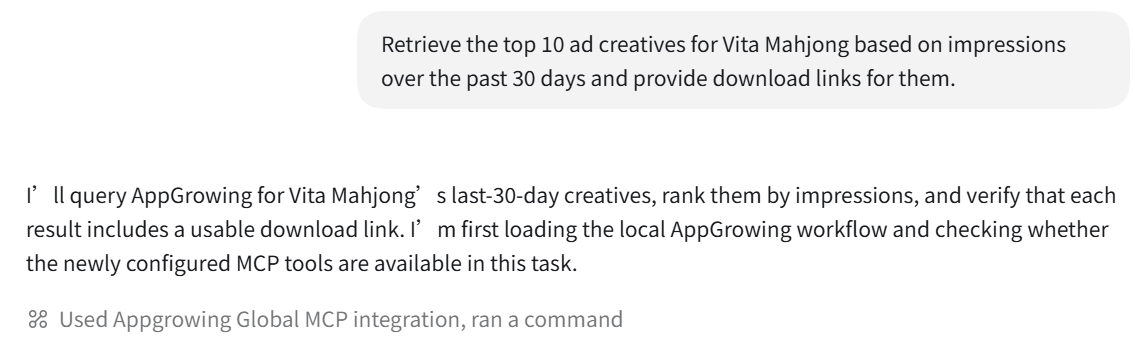
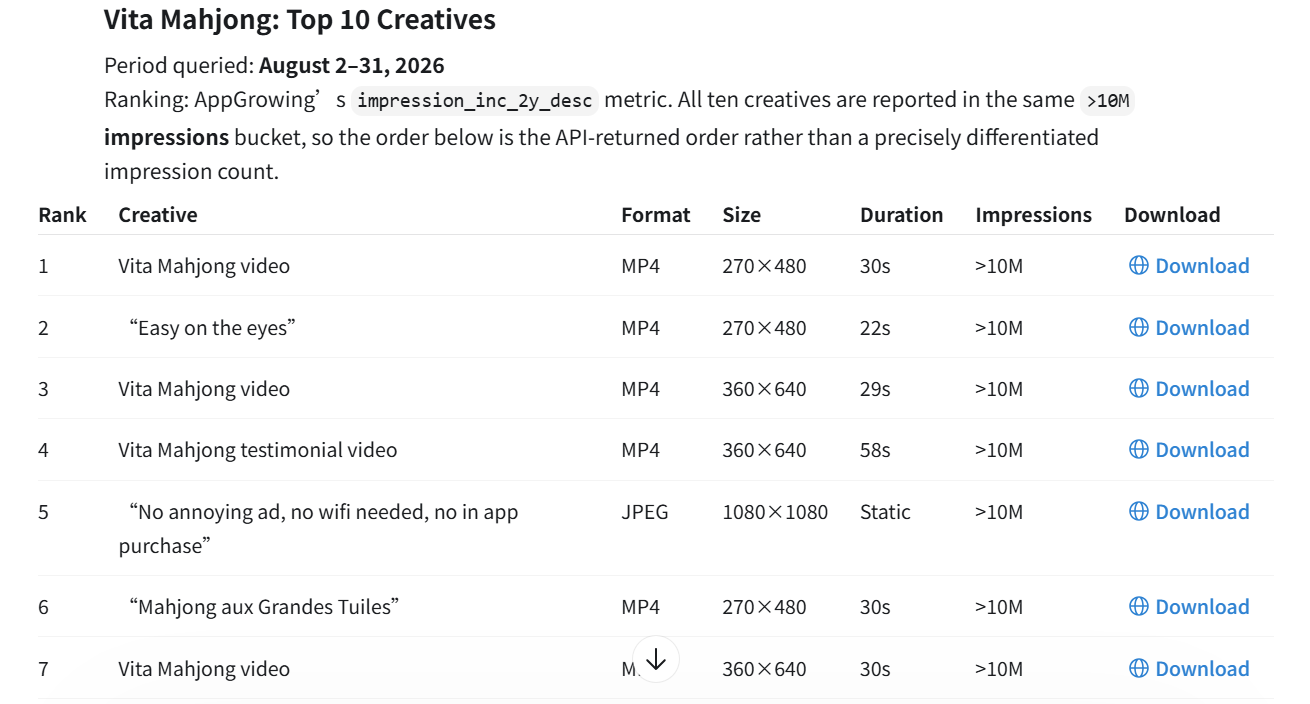
콜 체인:
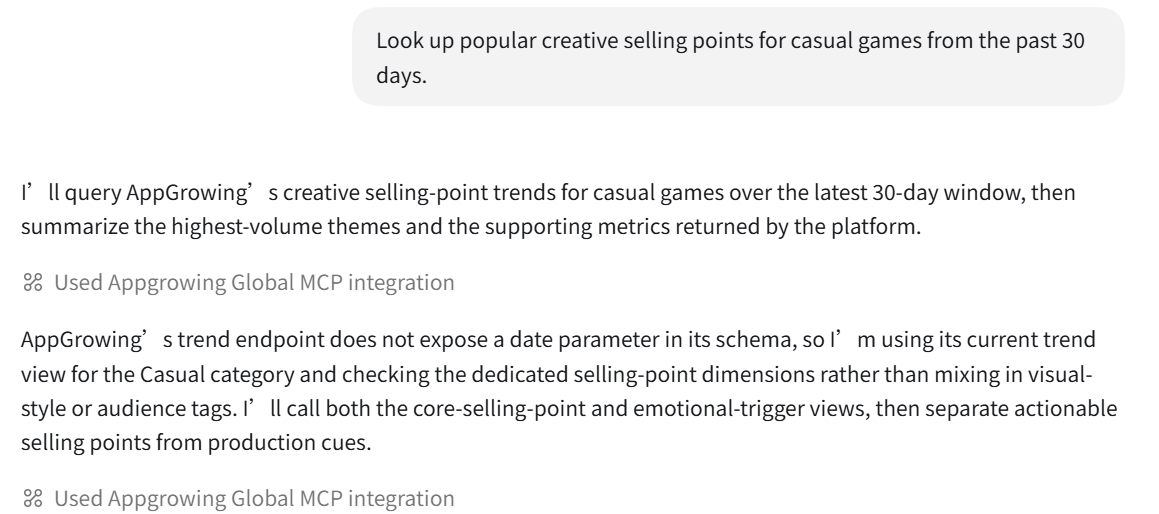
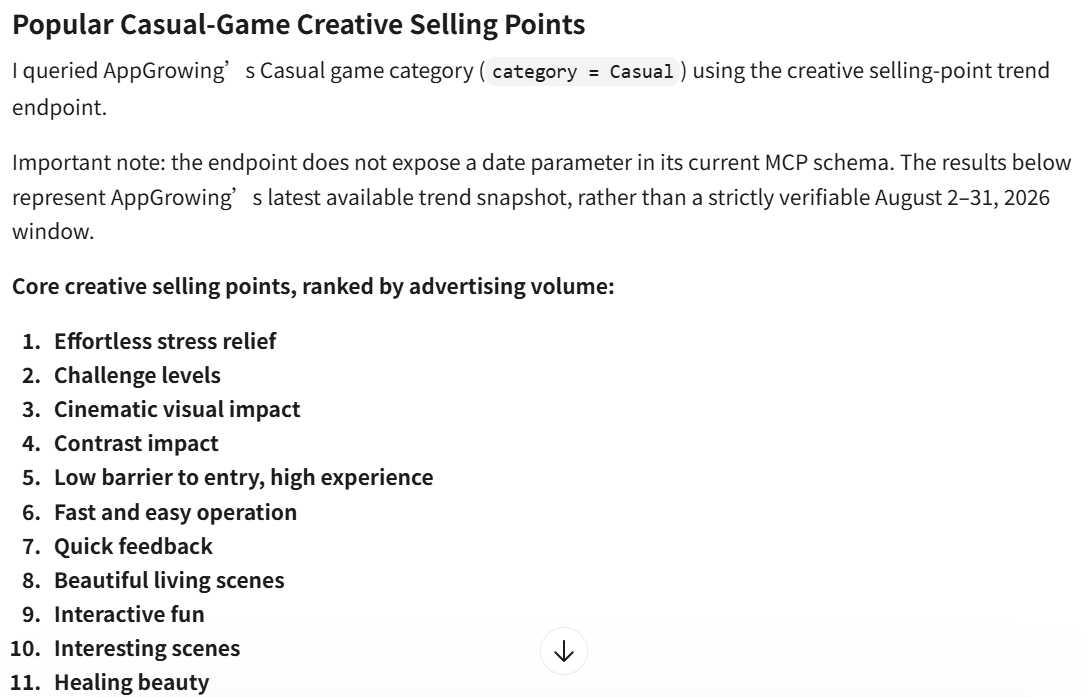
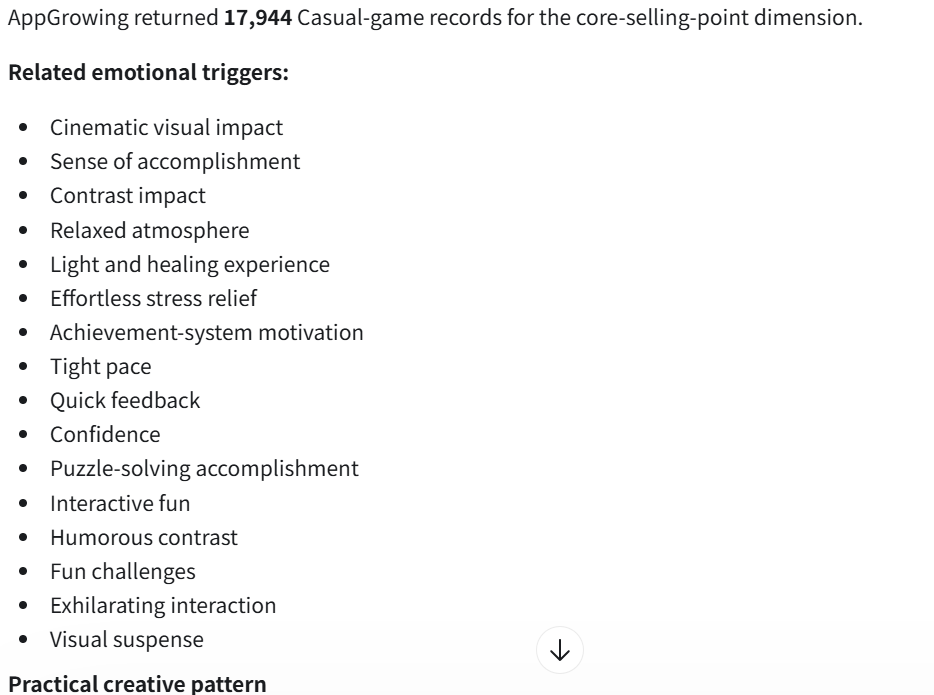
콜 체인:
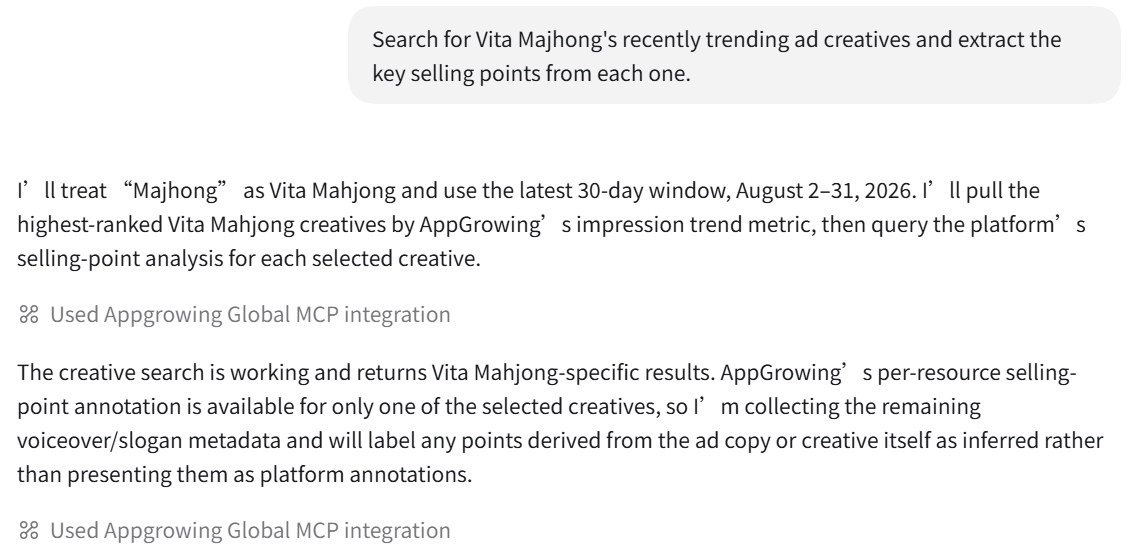
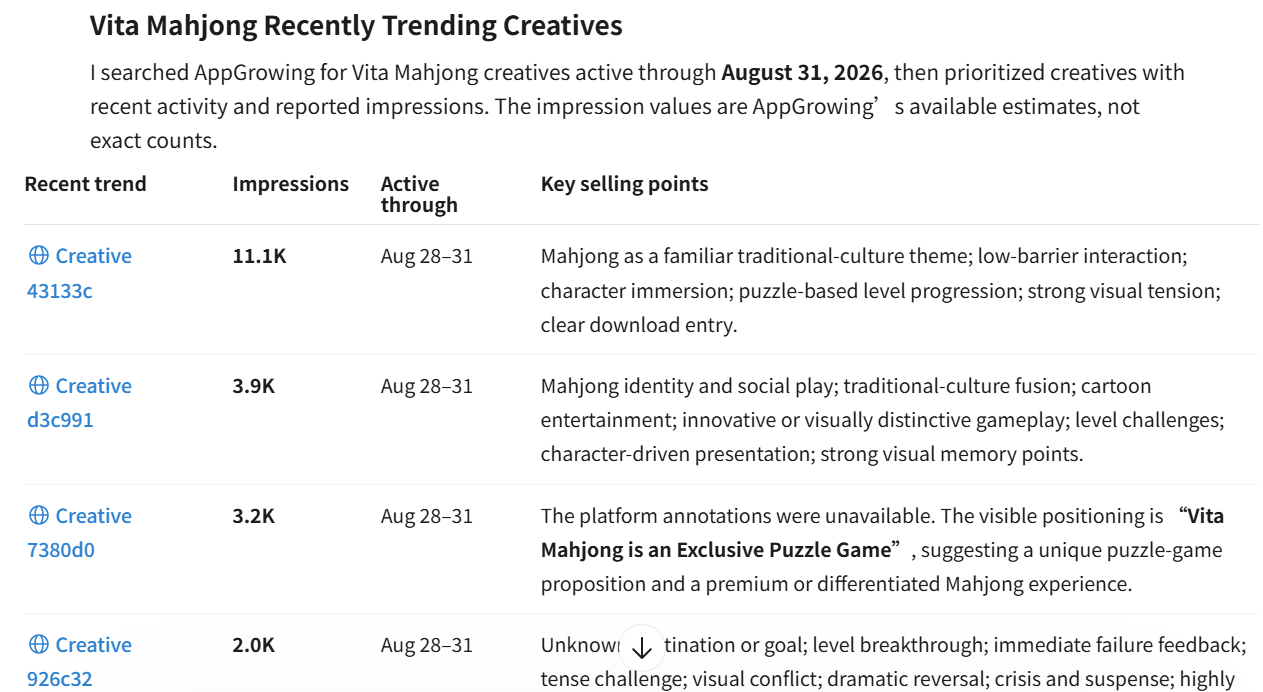
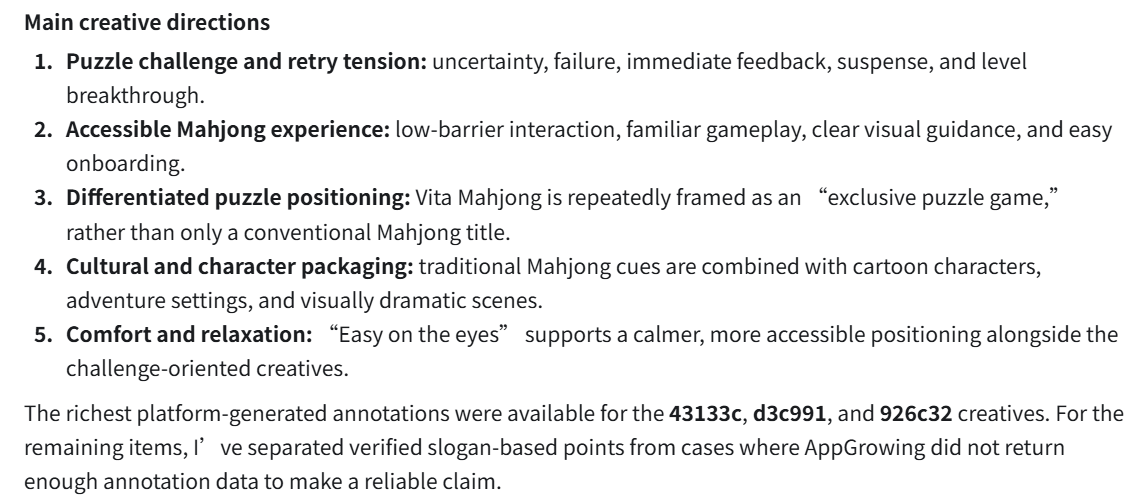
IVAppGrowing MCP 기본 사용 사례
요구:특정 카테고리에서 떠오르는 소재 방향을 찾고 어떤 판매 포인트를 활용할지 결정하세요.
조건:경쟁 앱을 잠그고 최근의 소재 플레이와 출시 강도를 분해합니다.
조건:목표 시장을 위해 참조할 수 있는 원본 광고 영상을 일괄 수집하고 현지화 팀을 위해 리메이크합니다.
조건:카테고리의 현재 주류 판매 포인트 테마와 소재 주제를 살펴보고 소재 주제를 안내하세요.
요구:다양한 채널/형식에 걸쳐 동일한 카테고리의 광고 스타일 차이를 비교해 보세요.
요구:새로운 시장에 진입하기 전에 초기 참조를 위해 해당 시장에서 동일한 카테고리의 벤치마크 광고 소재를 가져옵니다.
남은 사례
| 사례 연구 | 일반적인 문제 | 지원 도구 |
|---|---|---|
| 수익화 접근 방식 벤치마킹 | IAA와 IAP 게임의 소재 차이점은 무엇입니까? | searchAdCreatives (IAA/IAP 과금 방식 필터링 지원) |
| 청중 포지셔닝 연구 | 25~34세 여성을 타겟으로 하는 광고 소재인가요? | searchAdCreatives (성별 및 연령대 필터링 지원) |
| 홈페이지 / W2A 프로모션 분석 | 웹 프로모션 소재를 재생하는 방법은 무엇입니까? | searchAdCreatives (웹사이트를 홍보하는 소재 검색 지원) |
V고급 사용 시나리오
AppGrowing MCP를 얼마나 잘 활용할 수 있는지, 실제로 워크플로에 통합할 수 있는지는 주로 3가지 요인에 달려 있습니다:
- 에이전트의 역량
- AI 대규모 언어 모델(LLM)의 지능 수준
- 프롬프트를 얼마나 잘 작성했는지
좋은 프롬프트는 작업의 품질과 데이터 조회 범위를 결정합니다.
MCP를 자신만의 비즈니스 시나리오와 워크플로에 통합해 보시기 바랍니다. 에이전트가 MCP를 통해 데이터를 더 잘 호출하고, 이를 독창적인 데이터 인사이트로 전환해 자동화된 업무 효율화 프로세스로 내재화할 수 있습니다.
사업 목표:특정 제품에 대한 주간 소재 전략 브리핑을 자동으로 생성합니다. 캐스팅 중인 소재를 조사하고, 상승하는 판매 포인트를 파악하고, 다음 주의 소재 방향에 대한 제안을 제공합니다. 예정된 작업에 적합합니다(예: 매주 월요일 9:00).filterOptions & creativeAIAnalysisData치수를 잠그려면 →searchAdCreatives(캠페인_명 고급 검색 + 판매 포인트 필터링).
사용자가 트리거하는 프롬프트 참조:
📄 SKILL 참조(agg-single-product-report) - 클릭하여 접기
---
name: agg-single-product-report
description: This skill is applicable to: when the overseas mobile advertisement creative data of **single product/App** obtained based on AGG-MCP (searchAdCreatives, creativeAIAnalysisData, filterOptions, creativeResourceUrl) is required, when the Single Product Creative Strategy Diagnostic Report is produced. It focuses on a specific product (its own App or a single competitor), diagnoses its creative engine activity, selling-point focus, TOP creatives, creative life cycle and recession signal, and gives "amplification / iteration / elimination" creative asset disposal suggestions. Trigger scene: single product creative review meeting, own product creative health diagnosis, single competitor deep dismantling; or the user asked "help me systematically diagnose our XX game's creative play in the past month, which creatives should be added, changed or cut" / "deeply dismantle competitor YY's creative strategy in Japan".
agent_created: true
---

# AGG Single Product Creative Strategy Report

## Overview
AGG-MCP × Skill × Automation **single-scenario** analysis skill. It takes a normalized creative data set for a given product, converted into a structured **single-product creative strategy diagnostic report** (new scenario "F · Single-Product Creative Strategy Report"). Unlike "agg-category-report" (category level, cross-product), this skill only focuses on **one product** and does an in-depth physical examination of creative assets. This skill is decoupled from the MCP fetching layer: it consumes the `CreativeRecord[]` that is pulled and normalized by the MCP/orchestration layer in advance (recommended to use `searchDsl.campaign_name` to lock a single product), and does not call any tools by itself.

## When to call
- Single product creative review / own product creative health diagnosis (manual or Automation).
- Do a deep disassembly of one competitor (rather than a side-by-side comparison across competitors, which uses "agg-competitor-compare").
- Users ask questions such as "systematically diagnose the creative playing methods of our XX game in the past month, which should be added, changed, and cut" and "deeply dismantle competitor YY's creative strategy in Japan".

**Don't** use it to fetch data. If the `CreativeRecord` dataset is not available, run AGG-MCP first (filterOptions + creativeAIAnalysisData to lock dimensions → use `searchDsl.campaign_name` to lock a single product and pull searchAdCreatives, preferably covering multiple time slices), then return to this skill.

## Core Workflow
1. **Load contract**: Read `references/data_contract.md`, confirm required fields (`app_name`, `selling_points`, `format`, `ratio`, `language`, `impression`, `similar_cnt`, `advertising_days`, `max_dt`; ≥20 items in the product window).
2. **Issue analysis prompt**: Copy `references/analysis_prompt.md` and replace `<DATASET_SUMMARY>` / `<PARAMS>` (product name, region, time window), execute it.
3. **Apply deterministic rules** (see below, strictly as such):
   - **Creative engine activity**: total amount, number of new window items, `new_ratio`, and median of advertising_days.
   - **Selling-point focus**: TOP1 selling-point percentage; ≥40% judged "focused", <20% judged "scattered".
   - **TOP creatives**: impression / similar_cnt each take TOP5, mark "benchmark creative".
   - **Creative life cycle**: advertising_days distribution → distinguish evergreen (long cast) vs short-lived creatives; recession signal = few recent new items and old creatives still dominant.
   - **Disposal recommendations in three categories**: amplify (high performance and still worth casting), iterate (mediocre performance but form/selling points can be optimized), eliminate (low performance, long cast or declined).
4. **Delivery by envelope**: Fixed envelope (conclusion → evidence → recommendation → boundary). Recommendations given in "amplify / iterate / eliminate" three columns, each corresponding to specific creatives or selling points.
5. **Processing gaps**: When the sample is insufficient or a dimension is missing, only omit the corresponding subsection and mark at the boundary; no estimation allowed.

## Input/Output Contract (Abstract)
- **Input**: the `CreativeRecord[]` of a single product (time slices recommended to view evolution). Optionally with the same-category baseline for deviation comparison.
- **Output**: fixed-envelope Markdown insight block. Numbers must be calculated from the data set; if not available, write "insufficient data".

## Boundary Statement (key — must inform stakeholders)
This analysis uses **creative-side proxy metrics** (creative magnitude, similarity, exposure proxy, delivery days). It **is not** real delivery magnitude / consumption data (the latter requires `adVolumeTrends` / `regionOverview`). Each deliverable must be marked with: *"This analysis is based on creative-side proxy metrics, not true delivery magnitude."*
자동화된 작업 프롬프트 참조:
사업 목표:동일한 카테고리(예: 두 개의 SLG)에 있는 두 제품의 판매 전략 차이점(판매 포인트 초점, 미디어 선택, 지역 초점, 소재 스타일)을 비교하고 차별화된 경쟁 제안을 제공합니다.
도구 체인:searchAdCreatives× 2 (campaign_name으로 두 제품을 각각 잠김) → 수평 비교
사용자가 트리거하는 프롬프트 참조:
📄 SKILL 참조(agg-competitor-비교) — 클릭하여 접기
---
name: agg-competitor-compare
description: This skill is applicable to: when you need to obtain the overseas mobile advertising creative data of multiple competing apps through AGG-MCP (searchAdCreatives, creativeSellingPointTrends, filterOptions, creativeResourceUrl), when making a horizontal comparison of competitive creative delivery strategies. After normalizing the competitors' creative records, it produces structured cross-competitor comparisons — creative magnitude, new-launch rhythm (new ratio), media/format/language ratios, TOP selling points — and classifies each competitor as "adding party / changing party / keeping party" by hard rules, giving actionable follow-up recommendations for our side. Trigger scenario: competitor-monitoring weekly push (Automation) before the UA weekly meeting; or the user proposes "compare competitors XX and YY's buying creative methods this week" / "who is more radical, what selling points each promotes, and what are the channel and form differences".
agent_created: true
---

# AGG Competitor Creative Strategy Comparison

## Overview
Analysis skill for **single scenarios** within the AGG-MCP × Skill × Automation framework. It takes the normalized multi-competitor creative data set and converts it into a **competitor creative strategy comparison** report ready for the weekly meeting (scenario "A · Competitor launch strategy comparison push"). This skill is decoupled from the MCP fetching layer: it consumes the `CreativeRecord[]` pulled and normalized by the MCP/orchestration layer in advance; it does not call any tools by itself.

## When to Call
- Scheduled competitor-monitoring weekly push (Automation), used to synchronize intelligence before UA / buying weekly meetings.
- Users ask to compare competitors' creative buying methods, e.g. "Compare competitors XX and YY's buying methods in North America SLG: who is more radical? What selling points does each emphasize? What are the channel and form differences?"
- Any task that requires a side-by-side comparison of creative gestures for ≥2 competitors, rather than a single-brand perspective.

**Do not** use it to retrieve data. If there is no `CreativeRecord` data set, run AGG-MCP first (filterOptions → use `searchDsl.campaign_name` to pull searchAdCreatives for each competitor), then return to this skill.

## Core Workflow
1. **Load Contract**: Read `references/data_contract.md` and confirm the input matches the schema and this skill's required fields (`app_name`, `advertising_days`, `selling_points`, `media`, `format`, `language`, `similar_cnt`; at least 1 competitor ≥10 records).
2. **Issue the analysis prompt**: Copy `references/analysis_prompt.md`, replace `<DATASET_SUMMARY>` / `<PARAMS>` (competitor list, time window, target region), and execute it.
3. **Apply deterministic classification**: Compute `new_ratio = new-in-window count / total` per competitor; classify by hard rules — adding party `new_ratio ≥ 0.40` or highest absolute new count in the set; changing party `0.15 ≤ new_ratio < 0.40` with newer creatives; keeping party `new_ratio < 0.15`. Strictly follow this and do not invent categories.
4. **Delivery by envelope**: Wrap the output in the fixed envelope of `references/data_contract.md` (conclusion → evidence table → suggestion → boundary). Evidence table columns: "Competitor | Total | New ratio | Main media/format | TOP selling point | Classification". Give exactly 3 follow-up suggestions for our side.
5. **Processing gaps**: When a competitor's sample is below the lower limit, still output based on existing data and mark it in the boundary; no estimation allowed.

## Input/Output Contract (Summary)
- **Input**: `dict[app_name, CreativeRecord[]]` or flat `CreativeRecord[]` with `app_name`.
- **Output**: a fixed-envelope Markdown insight block. Numbers must be calculated from the data set; if unavailable, write "insufficient data".

## Boundary Statement (key — must be communicated to stakeholders)
This analysis uses creative-side proxy metrics (creative magnitude, new-launch rhythm, media/format/language ratios). It **is not** real delivery magnitude / consumption data (the latter requires `adVolumeTrends` / `regionOverview`, not in the current MVP). Each deliverable must be labeled: *"This analysis is based on creative-side proxy metrics and does not reflect actual ad-spend levels."*
자동화 작업 프롬프트 참조:
사업 목표:단일 제품에 초점을 두지 않고 전체 카테고리(예: 4X SLG)의 판매 포인트 동향을 요약하고, "현재 이 카테고리에서 어떤 판매 포인트가 인기가 있는지"에 답하여 신제품 프로젝트/소재 방향의 기초를 제공합니다.
도구 체인:filterOptions(카테고리 선택) →creativeSellingPointTrends(카테고리별로 필터링) →searchAdCreatives(최고 판매 포인트별 샘플 검증)
사용자가 트리거하는 프롬프트 참조:
📄 SKILL 참조(agg-판매점-추세) — 접으려면 클릭하세요.
---
name: agg-sellingpoint-trend
description: This skill is applicable to: when you need to obtain a category of overseas mobile ad creative data across two time slices based on AGG-MCP (searchAdCreatives, creativeSellingPointTrends, filterOptions, creativeResourceUrl), when summarizing "selling-point trend changes". It calculates the month-on-month ranking of selling points, marks emerging / declining selling points by fixed thresholds, and outputs a priority list for next month's creative topics. Trigger scenario: monthly creative topic-selection meeting; or the user asked "help me look at the creative selling-point trend of cross-border e-commerce last month: which selling points are rising and which are falling? What angle should I push next month".
agent_created: true
---

# AGG Category Selling-Point Trend Summary

## Overview
Analysis skill for **single scenarios** within the AGG-MCP × Skill × Automation framework. It converts two time-sliced category data sets into a structured **selling-point trend summary** (scenario "C · Category creative selling-point trend summary"). This skill is decoupled from the MCP fetch layer: it consumes the normalized `CreativeRecord[]` pulled in advance by the MCP/orchestration layer and sliced in time; it does not invoke any tools itself.

## When to Call
- Scheduled monthly trend briefing (Automation), used before creative topic selection.
- Users ask for selling-point heat trends, such as "last month's cross-border e-commerce selling-point trends: which are rising and which are falling? What should we push next month".
- Any task that needs to compare the changes of a category's selling-point pattern across two cycles.

**Do not** use it to retrieve data. If there is no data set, first run creativeSellingPointTrends (list all selling points) → searchAdCreatives for this category this month and last month respectively, then return to this skill.

## Core Workflow
1. **Load the contract**: Read `references/data_contract.md`, confirm required fields (`selling_points` and `impression` must cover **two** slices; ≥2 slices with ≥20 items each).
2. **Generate the analysis prompt**: Copy `references/analysis_prompt.md`, replace `<DATASET_SUMMARY>` / `<PARAMS>` (category, two slice definitions), and execute it.
3. **Apply deterministic labels**: Compute month-on-month creative-volume and ranking changes per selling point. Emerging selling point = growth ≥50% and last month's base <20; declining selling point = decline ≥30%. Combine emerging selling points with high-base steady-growth selling points to rank P0/P1/P2 priorities. Strictly follow the thresholds.
4. **Delivery by envelope**: Fixed envelope (conclusion → evidence table → recommendation → boundary). Evidence table columns: "Selling point | Last-month volume | This-month volume | Month-on-month | Ranking change | Label".
5. **Processing gaps**: When a slice is below the lower limit, still output based on existing data and mark at the boundary; missing slices cannot be estimated.

## Input/Output Contract (Summary)
- **Input**: category selling-point data grouped by two time slices (this month / last month).
- **Output**: a fixed-envelope Markdown insight block. Numbers must be calculated from the data set; if unavailable, write "insufficient data".

## Boundary Statement (key — must be communicated to stakeholders)
This analysis uses **creative-side proxy metrics** (creative volume, exposure proxy). It is not real delivery-level data (the latter requires `adVolumeTrends`). Each deliverable must be labeled: *"This analysis is based on creative-side proxy metrics and does not reflect actual ad-spend levels."*
자동화 작업 프롬프트 참조:
사업 목표:제품이나 카테고리에 대해 '어느 지역, 어느 미디어, 어떤 소재'가 가장 효과적인지 분석하여 예산 배분을 안내합니다.
도구 체인:searchAdCreatives(영역×미디어 크로스) →creativeResourceUrl(원본 광고 영상 샘플)
사용자가 트리거하는 프롬프트 참조:
📄 SKILL 참조(agg-region-media) — 접으려면 클릭하세요.
---
name: agg-region-media
description: This skill is applicable to: when you need to obtain the "region × media" creative data of overseas mobile advertising based on AGG-MCP (searchAdCreatives, creativeSellingPointTrends, filterOptions, creativeResourceUrl), when analyzing the region × media creative ecosystem. It maps the region × media creative landscape, marks channel concentration, describes cross-channel creative style differences, and outputs media budget priorities and risks. Trigger scenario: quarterly media budget planning or before entering a new market; or the user proposes "we are ready to enter Latin America — analyze the channel focus and creative style differences of Brazil / Mexico same-category creatives on TikTok and Meta, and which way the budget should be tilted".
agent_created: true
---

# AGG Region × Media Creative Ecosystem Analysis

## Overview
Analysis skill for **single scenarios** within the AGG-MCP × Skill × Automation framework. It takes (region, media) cross-grouped creative datasets and turns them into a structured **region × media creative ecosystem analysis** (scenario "D · Region and media delivery strategy analysis"). This skill is decoupled from the MCP fetching layer: it consumes the normalized `CreativeRecord[]` pulled and tagged by the MCP/orchestration layer in advance; it does not invoke any tools itself.

## When to Call
- Scheduled quarterly media budget review, or one-time analysis before entering a new market (Automation / manual).
- Users ask for region/media creative differences and budget inclination, such as "entering Latin America, analyzing Brazil/Mexico creative differences on TikTok and Meta — how should the budget be tilted".
- Any task that requires a region × media creative map rather than a single-channel perspective.

**Do not** use it to retrieve data. If there is no data set, run filterOptions (area codes / media IDs) → cross searchAdCreatives by area × media, then return to this skill.

## Core Workflow
1. **Load the contract**: Read `references/data_contract.md`, confirm required fields (`region`, `media`, `format`, `selling_points`, `advertising_days`; ≥3 (region, media) units with ≥5 items each).
2. **Generate the analysis prompt**: Copy `references/analysis_prompt.md`, replace `<DATASET_SUMMARY>` / `<PARAMS>` (region set, media set, time window), and execute it.
3. **Apply deterministic rules**: For each (region, media) unit output creative volume / form share / TOP selling points; channel concentration — a media's share within a region ≥50% marked "highly concentrated", otherwise "scattered"; creative style differences — qualitative description based on each media's format/language/selling_points combination; budget priority + risk (e.g. a highly homogenized channel → recommend differentiation or cost reduction).
4. **Delivery by envelope**: Standard envelope (conclusion → evidence → recommendations → boundaries). Units with sample <5 marked "insufficient sample" at the boundary.
5. **Processing gaps**: For missing units only omit that unit and enumerate at the boundary; no imputation.

## Input/Output Contract (Summary)
- **Input**: `CreativeRecord[]` with `region` and `media` tags (can be crossed).
- **Output**: a fixed-envelope Markdown insight block. Numbers must be calculated from the data set; if unavailable, write "insufficient data".

## Boundary Statement (key — must be communicated to stakeholders)
This analysis uses **creative-side proxy metrics** (creative magnitude, form/media/language percentages). It is not real delivery-level / consumption or media cost data (the latter requires `adVolumeTrends` / `regionOverview` / media APIs). Each deliverable must be labeled: *"This analysis is based on creative-side proxy metrics and does not reflect actual ad-spend levels."*
자동화 작업 프롬프트 참조:
사업 목표:매일 지정된 카테고리의 새로운 소재를 스캔하고, "신규 + 높은 노출"의 폭발 가능성을 찾아 첫 순간에 경고합니다. 예약된 작업에 적합합니다.
도구 체인:searchAdCreatives(isNew=1 + 최근 N일 + 노출 내림차순) →creativeResourceUrl
사용자가 트리거하는 프롬프트 참조:
📄 SKILL 참조(agg-viral-alert) — 접으려면 클릭하세요.
---
name: agg-viral-alert
description: This skill is applicable to: when you need to obtain a new-creative set based on AGG-MCP (searchAdCreatives, creativeSellingPointTrends, filterOptions, creativeResourceUrl) and compare against a ≥7-day baseline, monitoring overseas mobile advertising "viral creative burst signals". It applies three hard threshold gates (similar-count above P95 / exposure surge / ≥3 independent Apps focusing on the same selling point within 48h), and only sends an alert when at least one gate is hit. Trigger scenario: daily / conditional viral-creative monitoring (Automation); or the user asked "help me keep an eye on Japan-market RPG these two days for suddenly emerging viral creatives or new selling-point plays — if any, remind me immediately".
agent_created: true
---

# AGG Viral Creative Monitoring & Early Warning

## Overview
Analysis skill for **single scenarios** within the AGG-MCP × Skill × Automation framework. It converts the "new-creative set + baseline" into a **viral-creative alert** decision (scenario "E · Latest viral creative monitoring alert"). This skill is decoupled from the MCP fetching layer: it consumes normalized `CreativeRecord[]` (new creatives + baseline) pulled in advance by the MCP/orchestration layer, and does not call any tools or download creatives itself.

## When to Call
- Scheduled daily / high-frequency conditional monitoring tasks (Automation). Silence shall be maintained when there is no signal.
- Users ask to keep an eye on sudden viral creatives or new selling-point plays, e.g. "keep an eye on whether Japan RPG has any sudden viral creatives in the past two days, remind me if there are".
- Any task where the correct output when there is no signal should be "no anomaly" rather than fabricated insight.

**Don't** use it to fetch data or download creatives. The MCP layer is responsible for fetching; after a hit the MCP layer resolves `creativeResourceUrl`. If there is no data set, run searchAdCreatives (isNew=1, order=max_dt_desc, limited category/region) + 7-day baseline first, then return to this skill.

## Core Workflow
1. **Load Contract**: Read `references/data_contract.md`, confirm required fields (`creative_id`, `similar_cnt`, `impression`, `selling_points`, `media`, `max_dt`, `app_name`, `is_new`; baseline ≥7 days history; current window ≥1 item).
2. **Generate the analysis prompt**: Copy `references/analysis_prompt.md`, replace `<DATASET_SUMMARY>` / `<PARAMS>` (category, region, monitoring window), and execute it.
3. **Calculate the baseline first**: Take the P95 of `similar_cnt` and the median of `impression` per media over the past 7 days. If the baseline is <7 days → directly return "no anomaly (baseline under 7 days, no alert)" and stop.
4. **Apply three hard gates (alert on any hit)**: ① single `similar_cnt` > baseline P95; ② `impression` ≥ 3× the median of the same window and media (or day-on-day ≥200% if a time series exists); ③ the same `selling_points` delivered by ≥3 independent `app_name`s within 48h. **No relaxation allowed**.
5. **Delivery**: When hit — envelope with Headline = signal type; evidence table columns "Creative ID + detail-page link | Selling point | Main casting channel | Signal type"; recommended actions: follow-cast / avoid-pit / disassemble. When no gate is hit — return **only** "no anomaly", never fabricate signals.

## Input/Output Contract (Summary)
- **Input**: "new-creative `CreativeRecord[]`" + "≥7-day baseline" with consistent shapes.
- **Output**: either "no anomaly" (or the baseline-insufficient variant), or a fixed-envelope alert Markdown block.

## Boundary Statement (key — must be communicated to stakeholders)
This analysis uses creative-side proxy metrics (similar count, exposure proxy, selling-point co-delivery). It **is not** actual campaign volume data (the latter requires `adVolumeTrends`). When an alert is triggered, it must be marked: *"This alert is based on creative-side proxy metrics, not real delivery levels."*
자동화 작업 프롬프트 참조:
VIFAQ
- ① 그림 요소— 설명 및 값 포함: 라벨 태그 지정 방법을 알아보세요.
- ② 판매 포인트 심사— 300,000개 이상의 동적 어휘집; AI는 자동으로 새로운 판매 포인트를 생성하고 새로운 트렌드를 발견합니다.
- ③ 판매 포인트 추세— 카테고리의 최근 Top10 판매 포인트를 히트별로 정렬하여 직접 확인하여 '존재하는 것'이 아닌 '핫한 이유'를 알려줍니다.
🐍 Python 호출 스크립트 예 — 접으려면 클릭하세요.
import json, ssl, urllib.request

API_KEY = '<your key>'
URL = 'https://api-appgrowing-global.youcloud.com/mcp'

def mcp_call(name, args, timeout=90, retries=3):
    payload = json.dumps({'jsonrpc':'2.0','id':1,'method':'tools/call',
        'params':{'name':name,'arguments':args}}).encode()
    req = urllib.request.Request(URL, data=payload, method='POST', headers={
        'Content-Type':'application/json',
        'Accept':'application/json, text/event-stream',
        'accept-language':'en',
        'Authorization': f'Bearer {API_KEY}'})
    ctx = ssl.create_default_context()
    with urllib.request.urlopen(req, timeout=timeout, context=ctx) as resp:
        raw = resp.read().decode('utf-8')
    # SSE response: take the lines prefixed with "data: "
    for line in raw.splitlines():
        if line.startswith('data: '):
            return json.loads(line[6:])
    return json.loads(raw)

def parse(resp):
    return json.loads(resp.get('result',{}).get('content',[{}])[0].get('text','{}'))

# Example: search high-impression card-game creatives in the Japan market
inner = parse(mcp_call('searchAdCreatives', {
    'purpose': 1,
    'order': 'impression_inc_2y_desc',
    'startDate': '2026-07-10', 'endDate': '2026-08-10',
    'page': 1,
    'category': [2009],
    'area': ['JP'],
}))
ml = inner['data']['materialList']
print(f'total={ml["total"]}')
for item in ml['data'][:5]:
    m = item['material']
    game = (m['campaign'][0]['name'] if m.get('campaign') else '?')
print(f' {game} | {m.get("impression_inc_2y")} | {(m.get("creative") or {}).get("slogan","")[:40]}')creativeSellingPointTrends(판매 포인트 동향 목록)은 답변을 제공할 수 있는 유일한 도구입니다."이 판매 포인트가 최근 왜 인기가 있나요?". 따라서 AppGrowing MCP는 "광고하는 사람"부터 "광고 소재가 작동하는 이유"까지 전체 경로를 포괄하는 동시에 다른 소스가 제공할 수 없는 깊이를 유지합니다.- 클라이언트가 MCP 도구를 성공적으로 검색하지 못했습니다.
- 사용자 요청에 광고 소재를 검색하거나 분석하려는 의도가 명확하게 표현되어 있지 않습니다.
- 에이전트의 도구 호출 권한이 비활성화되었습니다.
- 스킬 또는 시스템 지침이 올바르게 로드되지 않았습니다.
- 도구 설명에 현재 에이전트와의 호환성 문제가 있습니다.